
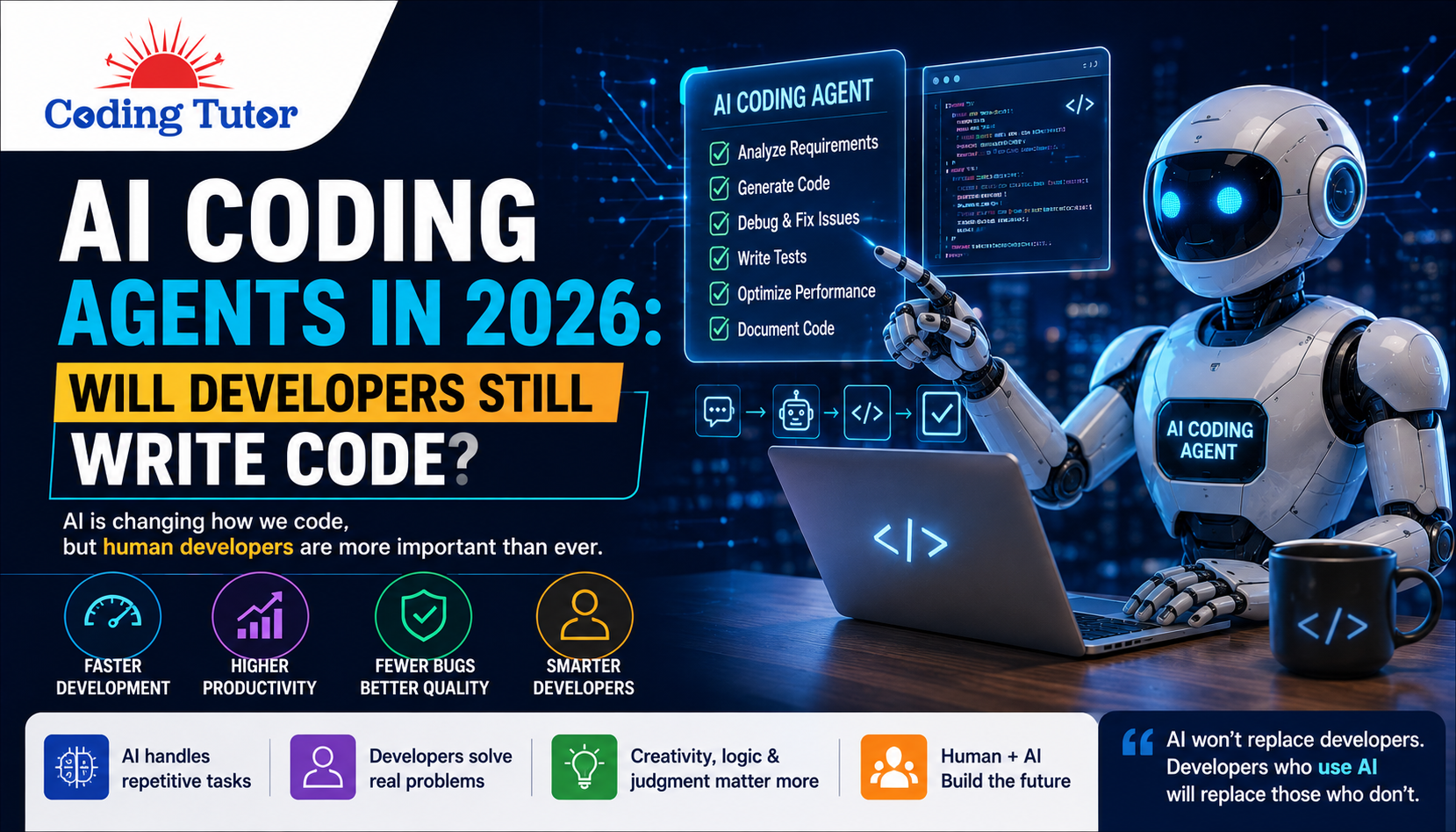
There was a time when learning software development meant spending hours writing every function, debugging every error, and searching through documentation whenever you got stuck. That world is changing.
In 2026, AI coding agents can do much more than autocomplete a few lines of code. Modern coding agents can analyze repositories, plan implementation steps, modify multiple files, run tests, and iterate on problems. Recent research is also exploring how these agents handle requirements, planning, and repository-level software tasks.
So naturally, students and developers are asking: if AI can write the code, why should I learn coding? The short answer is simple: generating code and engineering software are not the same thing.
What Are AI Coding Agents?
An AI coding agent is an AI-powered development system that can perform multiple software engineering tasks rather than simply suggesting a line of code.
Traditional AI coding assistants might suggest a function and generated code. An AI coding agent can work more like a loop: understand the requirement, inspect the project, create a plan, modify code, run tests, find errors, and improve the implementation.
This is why terms such as agentic coding, autonomous coding, and AI-assisted software development are becoming increasingly common. Tools such as GitHub Copilot, Claude Code, Codex, and Cursor represent different approaches to AI-powered development.
What Can AI Coding Agents Do?
AI coding agents are becoming useful for several everyday development activities.
1. Generate Code
Developers can describe a requirement in natural language and ask an AI coding tool to create an initial implementation. For example: create a REST API for user registration with validation and database integration. The agent may generate controllers, services, models, and supporting code. Generated code still needs human review.
2. Debug Software
AI coding tools can analyze error messages, inspect relevant code, and suggest potential fixes. This can save developers significant time when dealing with repetitive debugging tasks.
3. Write Tests
AI can generate unit tests, integration tests, and test cases based on existing functionality. That does not mean developers should blindly accept the tests. Poor requirements can result in poor tests.
4. Understand Existing Codebases
One of the biggest changes is the move from generating isolated snippets to working with existing repositories. Agents can inspect multiple files and attempt repository-level changes.
However, recent benchmark research found that popular coding agents still struggle with complete real-world requests, particularly when requirements are implicit or unclear. That limitation is important.
Will AI Replace Software Developers?
Not in the simple way many headlines suggest. AI is very good at repetitive tasks. Developers are still responsible for questions such as what we should build, why we are building it, what architecture to use, whether the generated solution is secure, whether it will scale, whether it meets business requirements, what happens when something goes wrong, and how different systems should communicate.
These are software engineering decisions. A developer who understands programming, databases, APIs, cloud infrastructure, and system design can use AI as a productivity multiplier. A person who only knows how to copy AI-generated code may struggle when the generated solution fails.
For a broader view of tools and career impact, read How AI Is Transforming Software Development in 2026.
The New Developer Skill: Working With AI
The valuable skill is not simply knowing AI. It is knowing how to combine programming fundamentals, AI tools, and software engineering judgment.
For example, a Java developer should still understand Java, Spring Boot, REST APIs, databases, authentication, and testing. AI can help accelerate those skills. It should not replace them. The same applies to Python developers, full-stack developers, cloud engineers, and DevOps professionals.
What Should Students Learn in 2026?
If you are a fresher or engineering student, do not choose between coding and AI. Learn both. A practical roadmap could look like:
- Programming fundamentals
- Data structures and algorithms
- Git and GitHub
- Database fundamentals
- Backend or frontend development
- APIs and real projects
- Cloud fundamentals
- AI coding tools
- AI and LLM integration
- Build and deploy real applications
This approach creates an AI-enabled software developer, rather than someone who simply depends on AI.
The Biggest Mistake to Avoid
Do not assume that if AI wrote it, it must be correct. AI can produce code that looks professional and still contains security vulnerabilities, incorrect business logic, poor error handling, performance problems, dependency issues, incorrect assumptions, and hidden edge cases. The developer remains accountable for the final product.
What This Means for Coding Careers
The software developer role is evolving. The industry is not moving from developers to AI. It is increasingly moving toward developers plus AI: AI-assisted software engineering. That distinction matters.
Companies need people who can understand technology, solve problems, and use modern tools effectively. For students, this means learning software development should not stop at syntax.
- Build projects
- Use Git
- Work with APIs
- Understand databases
- Deploy applications
- Use AI coding tools
- Review AI-generated code
- Understand why the code works
How Coding Tutor Approaches AI-Powered Development
At Coding Tutor, the focus is not simply teaching students how to generate code with AI. The stronger approach is to combine programming, AI, real project experience, and workplace-oriented development practices.
Students learning Java Full Stack with AI, Python Full Stack with AI, or Cloud with AI can build a foundation that reflects how modern development teams increasingly work.
The goal is simple: do not learn coding without AI, and do not use AI without understanding coding. Learn to become a developer who can use both.
Final Takeaway
AI is changing how software gets built. The developers who benefit most will not necessarily be the ones who write every line manually—they will be the ones who understand software deeply enough to direct, review, and improve AI-generated work.