
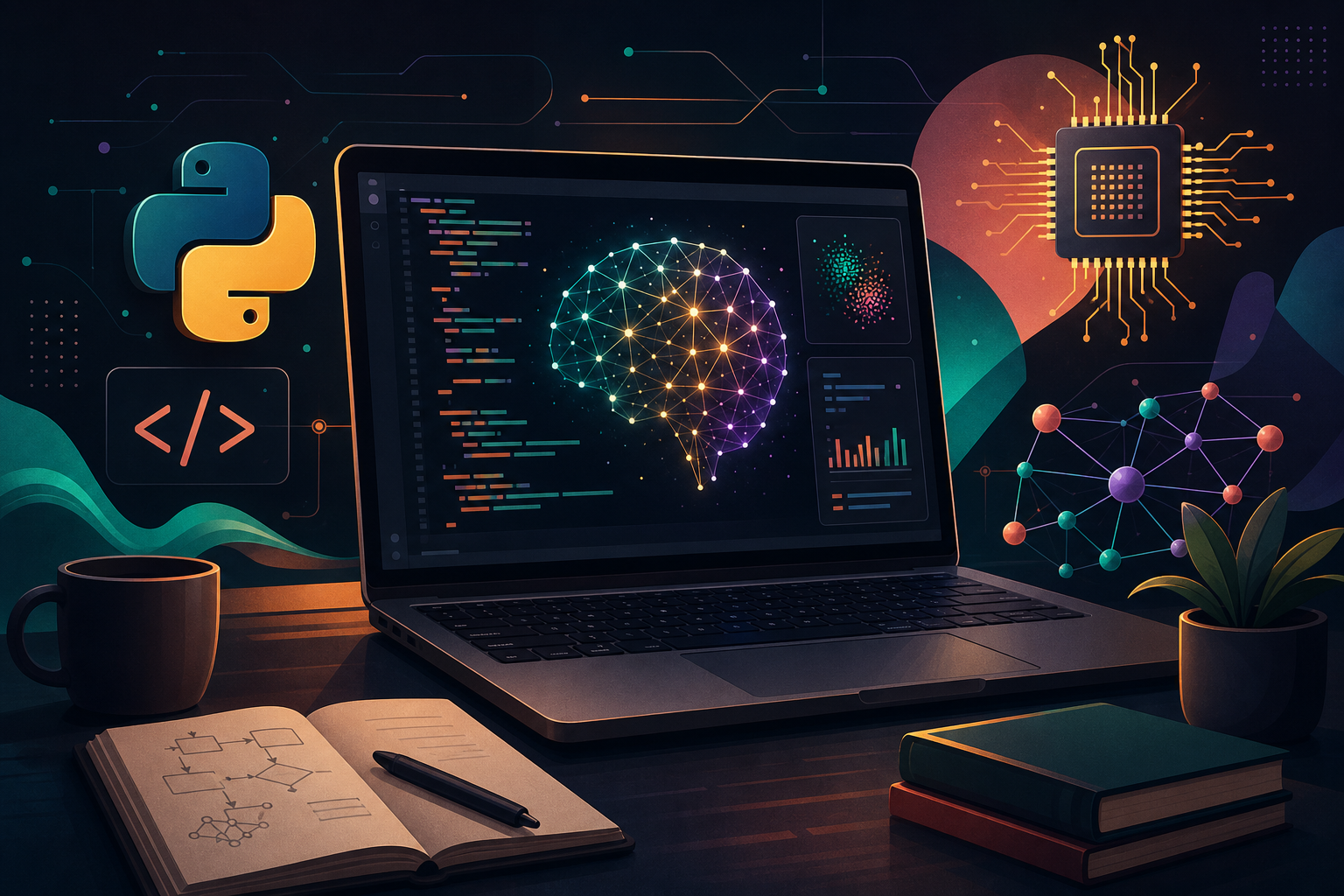
Artificial Intelligence (AI) is changing how software is built, tested, and maintained. Instead of replacing software engineers, AI is becoming a powerful tool that helps developers write better code, automate repetitive tasks, and solve complex problems more efficiently. To stay competitive, software engineers should focus on learning AI skills that complement their programming knowledge.
From smart recommendations to automation and intelligent search, AI is transforming every industry. Whether you want to build intelligent applications, integrate AI into existing products, or advance into high-demand roles, the right skill set can give you a strong competitive edge.
Here are the best AI skills every software engineer should learn:
1. Python Programming
Python remains one of the most widely used languages for AI and Machine Learning. Learning Python, along with libraries such as NumPy, Pandas, Scikit-learn, TensorFlow, and PyTorch, creates a strong foundation for AI development.
2. Machine Learning Fundamentals
Understanding supervised learning, unsupervised learning, classification, regression, clustering, and model evaluation helps software engineers build intelligent applications instead of simply consuming AI tools.
3. Generative AI & Prompt Engineering
Generative AI tools like ChatGPT and GitHub Copilot are becoming part of everyday software development. Learning prompt engineering and understanding how Large Language Models (LLMs) work can improve productivity while supporting better coding, debugging, documentation, and testing.
4. AI Frameworks & APIs
Modern developers should know how to integrate AI into web applications using APIs and frameworks. Building AI-powered chatbots, recommendation systems, and automation tools is increasingly valuable across industries.
5. Data Handling & SQL
AI depends on quality data. Skills in SQL, data cleaning, data analysis, and visualization help engineers prepare reliable datasets and build better AI-powered applications.
6. MLOps & Cloud
Knowing how to deploy AI models using Docker, CI/CD, REST APIs, AWS, Azure, or Google Cloud is an advantage for engineers working on production-ready applications.
7. AI Ethics & Responsible Development
Software engineers should understand privacy, security, fairness, and bias in AI systems. Building responsible AI solutions is an important part of professional software development.
Bonus Skills That Give You an Edge
- Generative AI application building with tools like ChatGPT APIs and Hugging Face.
- Prompt engineering for accurate, reliable outputs from large language models.
- AI developer tools for faster coding, debugging, and automation.
- Vector databases for semantic search and embedding-based applications.
Why These Skills Matter
Companies across industries are looking for engineers who can combine software development, Full Stack Development, Cloud Computing, DevOps, and AI to create scalable, intelligent applications. Practical experience is often as important as theoretical knowledge.
In-demand roles include AI Engineer, Machine Learning Engineer, Data Scientist, NLP Engineer, MLOps Engineer, Computer Vision Engineer, and AI Developer. Developers who adapt early and build real projects will be well-positioned for this evolving landscape.
At Coding Tutor, students gain hands-on experience through , Java Full Stack Development, React.js, Spring Boot, AI tools, Git, Agile workflows, and industry mentorship. Our focus is on helping learners build practical skills that employers value.
Future-proof your career by learning AI alongside strong software engineering fundamentals. The developers who adapt, build real projects, and continuously learn will be well-positioned for the evolving technology landscape.