
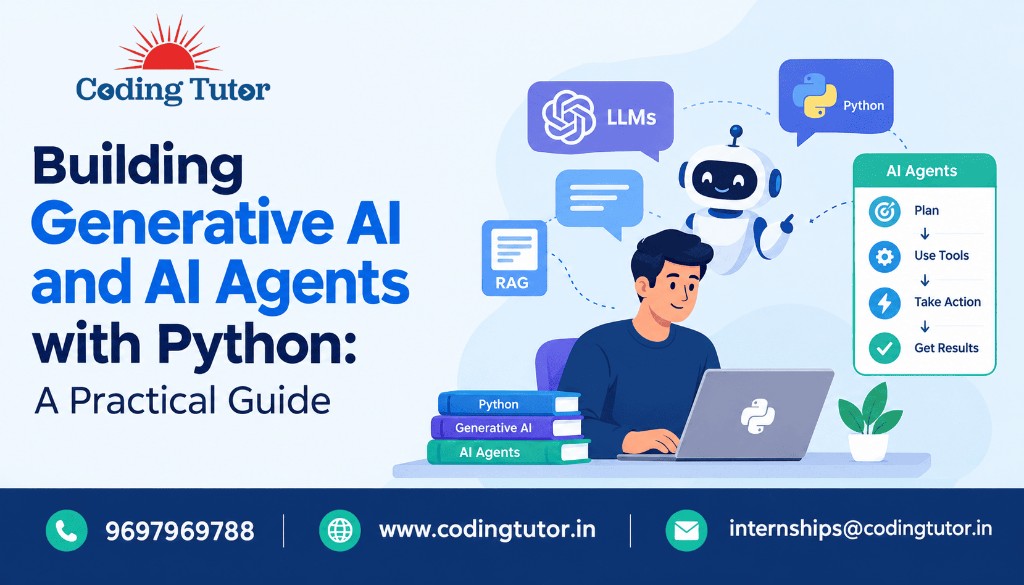
Artificial Intelligence is no longer just a topic discussed in technology conferences or research laboratories. It is becoming part of everyday software development, business operations, customer service, and digital products.
From AI-powered chatbots to intelligent workflow automation, Generative AI is changing how developers build and improve software applications.
But there is an important difference between using AI tools and knowing how to build AI-powered applications.
The future belongs to developers who can combine programming fundamentals, AI knowledge, and practical software development skills.
At Coding Tutor, we believe that understanding technology becomes more valuable when you can apply it to real-world problems. In this guide, let's explore how Python helps developers build Generative AI applications and AI agents, which projects you can start with, and how these skills can support your technology career.
What Is Generative AI with Python and Why Is It Important?
Generative AI is a branch of artificial intelligence that can generate new content, including text, code, summaries, and other outputs, based on patterns learned from data.
Python is widely used in AI development because it offers readable syntax, extensive libraries, and tools for connecting AI models with software applications.
With Python, developers can create applications such as:
- AI chatbots that answer questions using business documents.
- Intelligent assistants that summarize reports and extract information.
- AI-powered content and coding assistants.
- Customer support applications that retrieve relevant answers.
- Automated workflows that classify requests and prepare responses.
These applications demonstrate how Generative AI with Python can turn an idea into a useful software solution.
However, building reliable AI applications requires more than writing prompts. Developers must also understand APIs, data processing, application logic, testing, security, and deployment.
How to Build AI Agents with Python: A Step-by-Step Roadmap
Step 1 — Learn Python Programming for AI Development
Python programming is the foundation for building AI applications and intelligent agents.
Before moving into advanced AI frameworks, become comfortable with variables, functions, classes, modules, data structures, error handling, and object-oriented programming.
You should also understand REST APIs, JSON, HTTP requests, databases, and Git.
These fundamentals help you connect AI models to other systems and develop applications that are easier to test, maintain, and scale.
Step 2 — Understand Large Language Models and Prompt Engineering
Large Language Models (LLMs) power many modern Generative AI applications. They can interpret instructions, generate responses, summarize information, and support a wide range of language-related tasks.
Prompt engineering helps developers provide clear instructions, relevant context, and structured output requirements to these models.
For example, a developer could build a Python application that accepts a lengthy technical document and generates a concise summary with key points.
The goal is not simply to get an answer from an AI model. It is to make the model useful within a larger application.
Step 3 — Build Generative AI Applications Using RAG
Retrieval-Augmented Generation (RAG) combines information retrieval with AI-generated responses.
Instead of relying only on information learned during model training, a RAG application retrieves relevant content from an external knowledge source and supplies it to the model as context.
A practical Python RAG project could include:
- Uploading and processing PDF documents.
- Dividing documents into searchable sections.
- Generating embeddings and storing them in a vector database.
- Retrieving relevant information based on a user's question.
- Generating an answer grounded in the retrieved content.
- Evaluating answer quality and displaying source references.
For example, you could create an AI knowledge assistant that helps employees find answers in company documentation.
This project introduces developers to document processing, embeddings, vector search, LLM integration, and AI application evaluation.
Step 4 — Develop AI Agents with Python and Tool Integration
An AI agent can use a language model, approved tools, and a defined workflow to work toward a goal.
Unlike a basic chatbot that primarily responds to messages, an AI agent may select tools, retrieve information, call APIs, and perform multiple steps before presenting a result.
Consider a customer support scenario. An AI agent could classify a support request, retrieve relevant documentation, check information through an authorized API, and prepare a response for a human representative to review.
A practical AI agent architecture may include:
- Input processing: Understand the user's request.
- Task planning: Determine an appropriate sequence of steps.
- Tool calling: Interact with approved APIs, databases, or Python functions.
- Context management: Maintain relevant task information.
- Validation: Check outputs, handle errors, and enforce permissions.
- Response generation: Present the result in a clear format.
Frameworks such as LangChain and LangGraph can help developers build model integrations and multi-step workflows.
Importantly, reliable AI agent development also requires guardrails, access controls, testing, and human approval for sensitive actions. More autonomy does not automatically mean better results.
Best Generative AI and Python AI Agent Projects for Practical Learning
Reading about AI is useful, but implementing projects helps you understand the challenges involved in developing actual applications.
Project 1 — Generative AI Chatbot Using Python and RAG
Build a chatbot that answers questions from a collection of documents.
Include document ingestion, semantic search, LLM integration, source references, and an evaluation process to check whether the answers are accurate and relevant.
Project 2 — AI Research and Report Generation Agent
Create an assistant that gathers information from approved sources, summarizes findings, and organizes the results into a structured report.
Add source verification and human review so that unsupported information does not automatically become a final conclusion.
Project 3 — AI-Powered Workflow Automation Agent
Develop an agent that uses predefined tools to classify customer requests, retrieve information, or prepare draft responses.
Keep tool permissions limited and require approval before performing important or irreversible actions.
Project 4 — End-to-End Generative AI Software Application
Take your project beyond a notebook or simple demonstration.
Connect your Python AI backend to a database, application interface, APIs, automated tests, and a deployment environment.
This helps you understand the complete software development lifecycle, from requirements and implementation to testing, deployment, and maintenance.
Explore to discover how practical project experience can complement technical learning.
IT Courses After Engineering and Graduation: Why Learn Python and Generative AI?
For graduates exploring IT courses after engineering or IT courses after graduation, choosing the right learning path can feel overwhelming.
Java, Python, cloud computing, DevOps, cybersecurity, and artificial intelligence all offer different learning opportunities. The best choice depends on your interests, current knowledge, and the type of work you want to pursue.
If you are interested in AI-powered applications, Python and Generative AI can be a useful combination.
A structured learning roadmap could include:
- Programming fundamentals: Python, data structures, and problem-solving.
- Backend development: APIs, databases, and application architecture.
- Generative AI: LLMs, prompt engineering, embeddings, and RAG.
- AI agent development: Tool integration, workflow orchestration, and context management.
- Software engineering: Git, testing, debugging, and code quality.
- Deployment and monitoring: Application hosting, security, evaluation, and performance monitoring.
For students and graduates researching IT courses in Hyderabad, it is important to evaluate programs based on practical implementation, curriculum relevance, mentor support, and opportunities to build demonstrable projects.
A course should help you understand not only what a technology does, but also how to use it to solve real development problems.
Explore technology programs at Coding Tutor to review available learning pathways and identify the areas that match your career goals.
How Coding Tutor Connects Software Development Learning with Practical Projects
At Coding Tutor, our focus is on helping aspiring software professionals develop practical skills through technology learning and software project exposure.
Building applications gives learners opportunities to practise coding, debugging, version control, testing, collaboration, and problem-solving.
These skills matter because professional software development involves much more than writing individual functions. Developers must understand requirements, work with existing code, integrate systems, validate results, and improve applications over time.
For graduates exploring IT courses after engineering or graduation in Hyderabad, combining a strong programming foundation with practical project work can help build a more convincing technical portfolio.
Learn more about Coding Tutor and our software development approach, explore our internship project opportunities, and discover additional technical insights through our software development blogs.
The goal is to build the confidence to apply technical knowledge, demonstrate your skills, and continue learning as software engineering evolves.
Final Thoughts — Build Real Applications with Generative AI and Python
Generative AI is creating exciting possibilities for software developers, but the real value comes from applying these technologies thoughtfully.
Learn Python. Understand LLMs. Experiment with RAG. Develop AI agents that use tools responsibly. Build applications, test their outputs, and improve them based on real requirements.
For students and graduates considering IT courses after engineering or graduation in Hyderabad, the most important step is to move from simply consuming technology content to actively building and solving problems.
Don't just learn what AI can do. Learn how to build useful software with AI.
Start with one practical project, keep improving your skills, and turn your curiosity into something you can demonstrate.