
Have you ever used an AI tool to write content, generate images, explain code, or summarise a document and wondered how it actually works?
That curiosity can be the beginning of your Generative AI learning journey.
Generative AI is changing how people build software, automate tasks, analyse information, and solve business problems. But if you are a student, fresher, or working professional, knowing where to start can feel confusing. Should you learn Python first? Do you need machine learning knowledge? When should you start building AI applications?
The good news is that you do not need to learn everything at once.
In this guide, Coding Tutor explains how to learn Generative AI step by step, which skills to prioritise, and how to turn your knowledge into practical projects.
What Is Generative AI and Why Should Beginners Learn It?
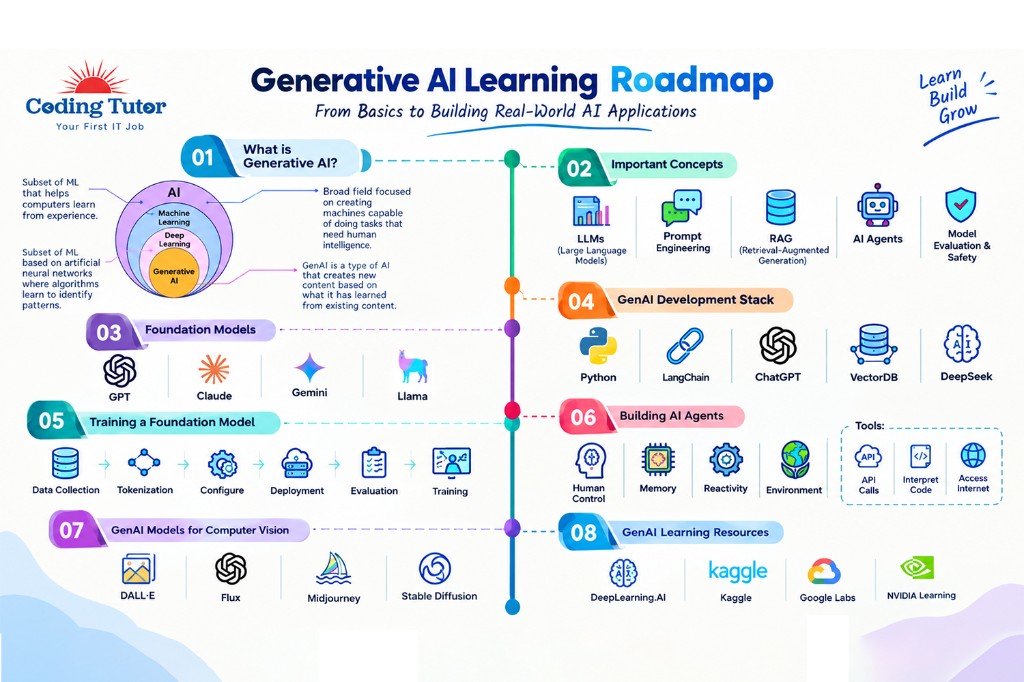
Generative AI refers to AI systems that can generate new content, including text, images, audio, video, and code, based on patterns learned from data.
Examples include AI writing assistants, document question-answering systems, coding assistants, image generators, and AI-powered customer support applications.
For aspiring software developers, learning Generative AI can expand your existing programming skills. Instead of only using AI tools, you can learn to build applications that integrate language models, retrieve information, and automate workflows.
The key is to focus on understanding how these systems work rather than simply learning how to write prompts.
Complete Generative AI Roadmap for Beginners: Step-by-Step Learning Path
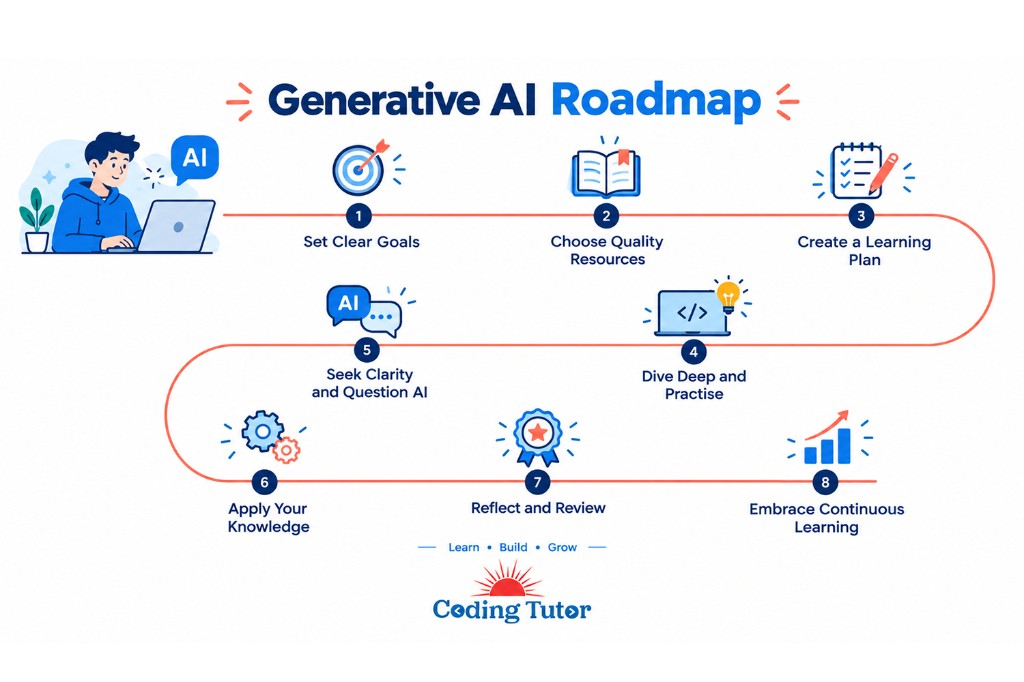
Step 1: Learn Python Programming for Generative AI
Python is a useful starting point for Generative AI development because it has a broad ecosystem of libraries and tools for data processing, machine learning, and AI application development.
Start by learning:
- Variables, data types, loops, and conditional statements.
- Functions, modules, and error handling.
- Lists, dictionaries, and other data structures.
- Object-oriented programming fundamentals.
- Working with APIs, JSON, and basic databases.
Practical task: Build a Python application that accepts user input, processes it, and displays the result. Then learn how to connect it to an external API.
You do not need to master every advanced Python concept before exploring AI. Build a solid foundation and improve it as your projects become more complex.
Step 2: Understand Machine Learning and Deep Learning Fundamentals
Before diving deeper into Generative AI, understand the basic ideas behind machine learning and neural networks.
Learn what training data is, how models identify patterns, what training and inference mean, and how model performance is evaluated.
You should also become familiar with neural networks, embeddings, and the basic intuition behind transformers.
You do not need to begin with advanced mathematics. Learn the concepts gradually and explore the mathematics in greater depth as your interests develop.
Step 3: Learn Large Language Models and Prompt Engineering
Large language models (LLMs) power many text-based Generative AI applications.
Start by understanding tokens, context windows, model inputs and outputs, and why AI systems can sometimes produce incorrect or fabricated information.
Next, practise prompt engineering.
Learn how to:
- Write clear instructions with a defined objective.
- Provide relevant context and examples.
- Specify the desired output format.
- Break complicated tasks into smaller steps.
- Test different prompts and compare their results.
Practical project: Create a Python-based text summariser or an interview preparation assistant using an LLM API.
Remember that effective AI development requires more than prompting. You must also verify results, handle errors, and evaluate output quality.
Step 4: Learn Retrieval-Augmented Generation (RAG)
One important Generative AI skill is learning how to connect an AI model to relevant external information.
Retrieval-Augmented Generation, or RAG, retrieves relevant information from a knowledge source and supplies it to a language model to help generate a grounded response.
Learn the basics of document processing, text chunking, embeddings, vector search, retrieval, and source attribution.
Practical project: Build a document question-answering application that allows users to upload study notes or company documents and ask questions about their contents.
This project helps you understand how AI applications can work with information beyond a model's built-in knowledge.
Step 5: Explore AI Agents and Workflow Automation
After learning the fundamentals of LLM applications and RAG, explore AI agents.
AI agents can use tools and follow multi-step workflows to complete tasks. Depending on their design, they may call APIs, retrieve information, update records, or coordinate different operations.
Learn about tool calling, workflow orchestration, state management, error handling, and human approval for important actions.
Practical project: Build a support assistant that classifies incoming requests, searches a knowledge base, and drafts responses for a human to review.
Start with a predictable workflow before attempting complex autonomous agents. Reliable behaviour matters more than adding unnecessary complexity.
Step 6: Learn AI Evaluation, Safety, and Deployment
A working demonstration is not the same as a reliable application.
Learn how to test AI outputs, identify hallucinations, protect sensitive information, manage API credentials, and monitor application performance.
Explore basic deployment using a web framework or cloud platform. Understand latency, cost, access control, logging, and responsible AI practices.
Fine-tuning is another useful topic, but it is not always the next step. First learn prompting, retrieval, and evaluation. Consider fine-tuning when testing shows that the model needs specialised behaviour that other approaches cannot adequately provide.
Best Generative AI Projects for Beginners to Build a Portfolio
The best way to strengthen your Generative AI skills is to build projects that solve clear problems.
Here are four ideas to get started:
- AI document assistant: Ask questions about PDFs and receive answers supported by retrieved passages.
- AI interview preparation tool: Generate practice questions, assess responses against a rubric, and suggest areas to improve.
- AI-powered FAQ assistant: Answer common customer questions using an approved knowledge base.
- AI workflow assistant: Use tools and APIs to organise tasks, retrieve information, or prepare reports with human review.
For every project, document the problem, the technologies used, the design decisions, the limitations, and how you tested the results. A well-explained project is more valuable than a collection of copied code examples.
Generative AI Skills for Freshers: IT Courses After Engineering and Graduation in Hyderabad
If you are exploring IT courses after engineering or IT courses after graduation, Generative AI may be one of the areas worth considering alongside software development fundamentals.
For freshers, a practical learning path could include Python, APIs, databases, Git, LLM integration, RAG, and project development. Your exact path will depend on your current programming knowledge and career goals.
For learners in Hyderabad, compare AI courses and programmes based on practical assignments, mentor guidance, project reviews, and opportunities to build applications independently.
At Coding Tutor, we encourage aspiring software professionals to connect technical learning with practical development. Explore Coding Tutor to learn about the company and its learning resources.
You can also review our programmes for aspiring software professionals and explore How AI Is Transforming Software Development in 2026.
If you are looking for structured learning options, start by identifying your skill gaps and comparing the available learning paths before making a decision.
How Long Does It Take to Learn Generative AI?
The timeline depends on your background, available study time, and the depth of knowledge you want to develop.
A possible learning plan for someone who already knows basic Python is:
- Weeks 1–2: Revise Python, APIs, and essential programming concepts.
- Weeks 3–4: Learn LLM fundamentals and prompt engineering.
- Weeks 5–6: Build an introductory AI application and explore embeddings and RAG.
- Weeks 7–8: Develop a more complete project, evaluate its results, and practise deployment.
This is an illustrative eight-week starting plan, not a guarantee of mastery or job readiness. Beginners may need additional time for Python and machine learning fundamentals, while advanced topics such as production-scale AI systems require continued practice.
Final Thoughts: Start Learning Generative AI by Building Something Useful
You do not need to become an expert in every AI technology before you start creating applications.
Learn Python, understand how language models work, practise prompt engineering, explore RAG and AI agents, and build projects that solve real problems. Test your applications carefully and learn from the mistakes you discover along the way.
If you are a fresher, an engineering graduate, or someone exploring IT courses after graduation, focus on developing skills you can demonstrate rather than collecting tools and certificates.
Your first step today: Choose one small problem and build a simple AI-powered solution. Then improve it one feature at a time.
Visit Coding Tutor to explore our learning resources and available programmes.