
Every day, thousands of students complete programming courses, earn certificates, and proudly add new skills to their resumes.
Yet, many of them still struggle to answer one question:
"Why am I not getting interview calls?"
The answer is simple—but often overlooked.
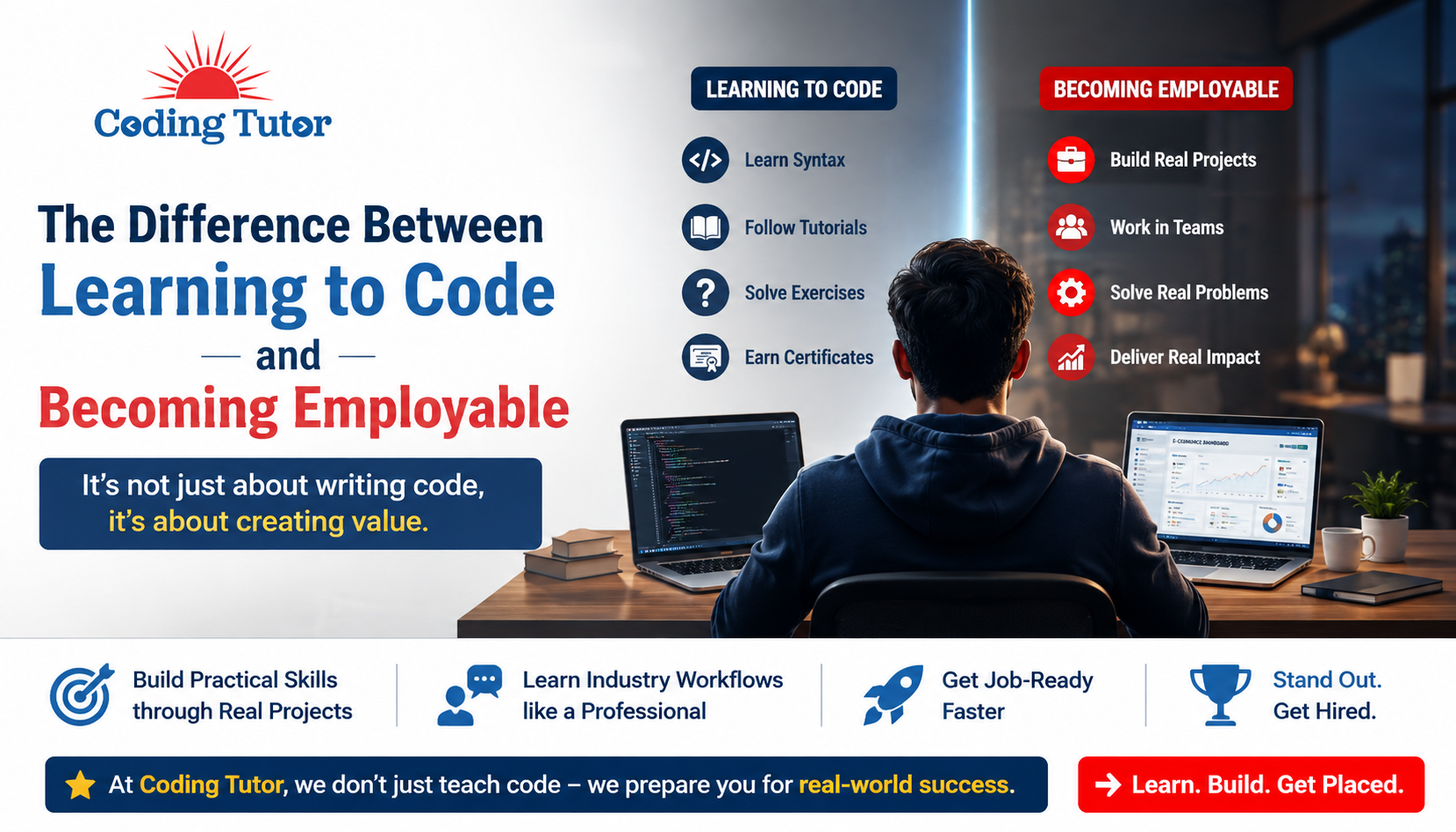
Learning to code and becoming employable are two completely different journeys.
Knowing Syntax Isn't the Same as Solving Problems
Most students spend months learning Java, Python, JavaScript, SQL, or React. They can explain concepts, solve textbook exercises, and even score well in online assessments.
But when they sit in an interview, they're asked questions like:
- Tell us about a project you built.
- How did you solve a real production issue?
- Have you worked with Git?
- How do you collaborate with a team?
- Have you deployed an application?
This is where many candidates struggle—not because they lack intelligence, but because they haven't had opportunities to apply what they learned.
Companies don't hire programming languages.
They hire people who can use those languages to solve business problems.
The Reality of Today's Hiring Market
Technology has evolved rapidly over the past few years.
Artificial intelligence is changing the way software is built.
Development teams are working faster.
Automation has reduced repetitive work.
Because of this, employers expect freshers to contribute much earlier than before.
Recruiters are increasingly looking beyond certificates. They want candidates who can demonstrate practical skills, communicate effectively, and adapt to modern development workflows.
What Makes Someone Employable?
Being employable isn't about knowing everything.
It's about proving that you can learn, build, collaborate, and deliver.
Employers often value candidates who can:
- Build complete applications instead of only completing tutorials.
- Work with version control systems like Git.
- Understand Agile development practices.
- Write clean, maintainable code.
- Debug and solve real-world problems.
- Communicate ideas clearly.
- Learn new technologies quickly.
These qualities help employers feel confident that a candidate can contribute to a team.
Real Projects Change Everything
There's a big difference between following a YouTube tutorial and building a project from scratch.
When you build something real, you experience challenges that no tutorial can fully prepare you for.
You learn to:
- Handle unexpected errors.
- Design solutions instead of copying them.
- Read documentation.
- Work with APIs.
- Fix bugs.
- Improve performance.
- Test your application.
- Receive feedback and iterate.
These experiences build confidence—and confidence shows during interviews.
Soft Skills Matter More Than Many Students Realize
Technical skills may help you get shortlisted.
Communication skills often help you get selected.
Many graduates underestimate the importance of explaining their ideas, presenting projects, asking thoughtful questions, or working with teammates.
In most software companies, developers collaborate with designers, testers, product managers, and clients.
The ability to communicate effectively can make a meaningful difference in your career.
AI Is a Tool, Not a Replacement
Many students worry that AI will replace software developers.
A more practical perspective is that AI is changing how developers work.
Modern developers use AI tools to:
- Generate code drafts.
- Debug faster.
- Understand unfamiliar technologies.
- Improve productivity.
But AI still depends on developers who understand requirements, architecture, testing, security, and business goals.
Learning how to work with AI is becoming an important professional skill.
Stop Collecting Certificates
One common mistake among fresh graduates is constantly enrolling in new courses without applying what they've already learned.
Instead of earning your tenth certificate, consider spending that time on:
- Building portfolio projects.
- Contributing to open-source repositories.
- Improving your GitHub profile.
- Writing technical blogs.
- Participating in hackathons.
- Practicing coding interviews.
- Learning system thinking and problem-solving.
Your portfolio often tells a stronger story than a long list of certificates.
Think Like a Professional Before You Become One
One mindset shift can accelerate your growth:
Don't think like a student waiting to be hired.
Start thinking like a software engineer solving problems.
Ask yourself:
- Can I build this feature?
- Can I improve this application?
- Can I automate this process?
- Can I explain my decisions?
Employers appreciate candidates who demonstrate curiosity, ownership, and a willingness to learn.
Final Thoughts
The technology industry doesn't just need people who know programming syntax.
It needs professionals who can create value.
Learning to code is an important first step.
Becoming employable means combining technical knowledge with practical experience, communication, teamwork, adaptability, and continuous learning.
If you're beginning your software engineering journey, don't focus only on completing courses.
Focus on building things.
Focus on solving problems.
Focus on learning continuously.
Because at the end of the day, companies don't hire people simply because they completed a course.
They hire people who are ready to contribute from day one.
What do you think is the biggest gap between college learning and industry expectations? Share your thoughts in the comments—we'd love to hear your perspective.