
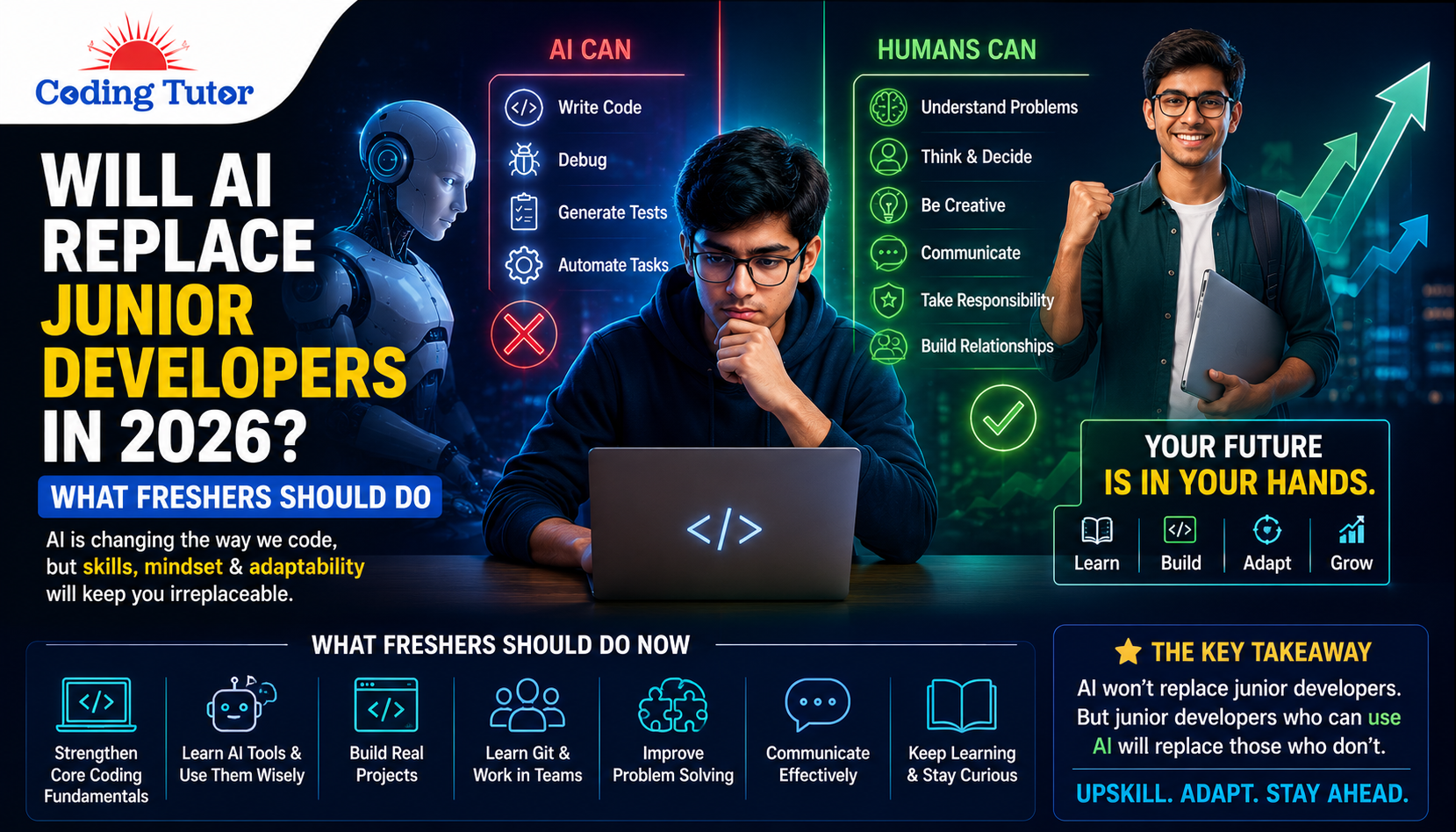
If you are a final-year student or recent graduate hoping to start a software career, you have probably seen the headlines: AI is replacing programmers, junior developer jobs are disappearing, and AI can code faster than humans. It is understandable if those headlines make you nervous.
But the reality is more complicated. AI is definitely changing entry-level software development. Some repetitive tasks traditionally given to junior developers can now be automated or accelerated. At the same time, companies still need early-career talent to build a sustainable engineering pipeline.
So the better question is not whether AI will eliminate junior developers. It is what companies will expect from junior developers in an AI-first workplace.
Why Junior Developers Are Feeling the Pressure
Traditionally, junior developers often started with tasks such as writing boilerplate code, fixing simple bugs, creating basic tests, updating documentation, building simple CRUD features, and making minor UI changes.
AI tools can now accelerate many of these activities. That means simply knowing how to write basic code may no longer be enough. The entry-level developer of 2026 needs to bring something more.
Skill 1: Understand Programming Fundamentals
Do not abandon Java, Python, JavaScript, or other programming languages because AI can generate code. Instead, understand them better. You should know variables and data types, functions, object-oriented programming, collections, error handling, APIs, databases, data structures, algorithms, and testing.
Why? Because when AI produces something incorrect, you need enough knowledge to recognize the problem.
Skill 2: Learn AI-Assisted Development
AI should not be treated as cheating. It should be treated as a development tool. Learn how to write clear technical prompts, ask AI to explain code, generate test cases, debug errors, refactor code, review generated code, analyze documentation, and work with AI coding agents.
The goal is not to become dependent on AI. The goal is to become more productive because you understand how to use AI properly.
Skill 3: Build Real Projects
A certificate can show that you completed a course. A project can show what you can actually do. Build applications that demonstrate authentication, REST APIs, database integration, frontend and backend communication, testing, Git workflows, deployment, and AI integration.
Even better, document your architecture and decisions. That gives recruiters something concrete to evaluate. See How Real-Time Projects Help You Get Hired Faster.
Skill 4: Learn Problem Solving
AI can generate five possible solutions in seconds. But which solution is appropriate? That is where problem-solving ability matters. A strong developer asks what the actual problem is before asking what code to write.
This is becoming increasingly important because modern AI coding agents can generate substantial amounts of code, while research still identifies requirement understanding as a major limitation.
Skill 5: Communication Matters More Than You Think
Software development is not an individual typing contest. Developers communicate with product managers, designers, QA engineers, senior developers, clients, and business teams.
You need to explain what you built, why you built it this way, what problem it solves, and what the limitations are. Good communication can make a technically capable fresher much more effective.
Skill 6: Learn Git and Team Workflows
If you are serious about becoming employable, learn how professional teams work. Understand Git, GitHub, pull requests, code reviews, branching, issue tracking, Agile, and CI/CD basics.
AI can generate a pull request. It cannot replace your responsibility for understanding what belongs in that pull request.
So, Are Junior Developers Finished?
No. But the definition of a junior developer is changing. A developer who only knows basic syntax may face greater competition. A junior developer who can code, use AI, understand systems, solve problems, and communicate has a much stronger proposition.
This is also consistent with recent reporting that software engineering hiring is increasingly testing AI skills alongside technical judgment and problem solving. Pair this with AI Skills Freshers Need to Get a Software Job in 2026 for a practical skill list.
What Freshers Should Do Right Now
If you are graduating in 2026 or preparing for a software job, do not spend months worrying about whether AI will replace you. Use that time to prepare. Your practical roadmap:
- Learn
- Build
- Use AI
- Test
- Deploy
- Document
- Apply
Do not just watch coding tutorials. Build something. Do not just generate code with AI. Understand it. Do not just collect certificates. Create evidence of your skills.
The Future Belongs to AI-Augmented Developers
The strongest career strategy is not human or AI. It is human plus AI. AI can help developers move faster. Human developers still provide context, judgment, responsibility, creativity, and communication.
For students, this is actually an opportunity. You do not have to compete with AI by trying to type faster than AI. You need to learn how to work intelligently with it.
How Coding Tutor Can Help Students Prepare
Coding Tutor's AI-focused learning approach combines programming and modern development practices. Whether a learner chooses Java Full Stack with AI, Python Full Stack with AI, or Cloud with AI, the objective is to move beyond theoretical coding and develop practical software engineering capability.
Learn the fundamentals. Build real projects. Use AI intelligently. Develop workplace skills. Become job-ready.
Final Takeaway
AI may change the entry point into software development, but it does not remove the need for people who can understand problems and build reliable software. The fresher who adapts will be in a much stronger position than the fresher who ignores AI.