
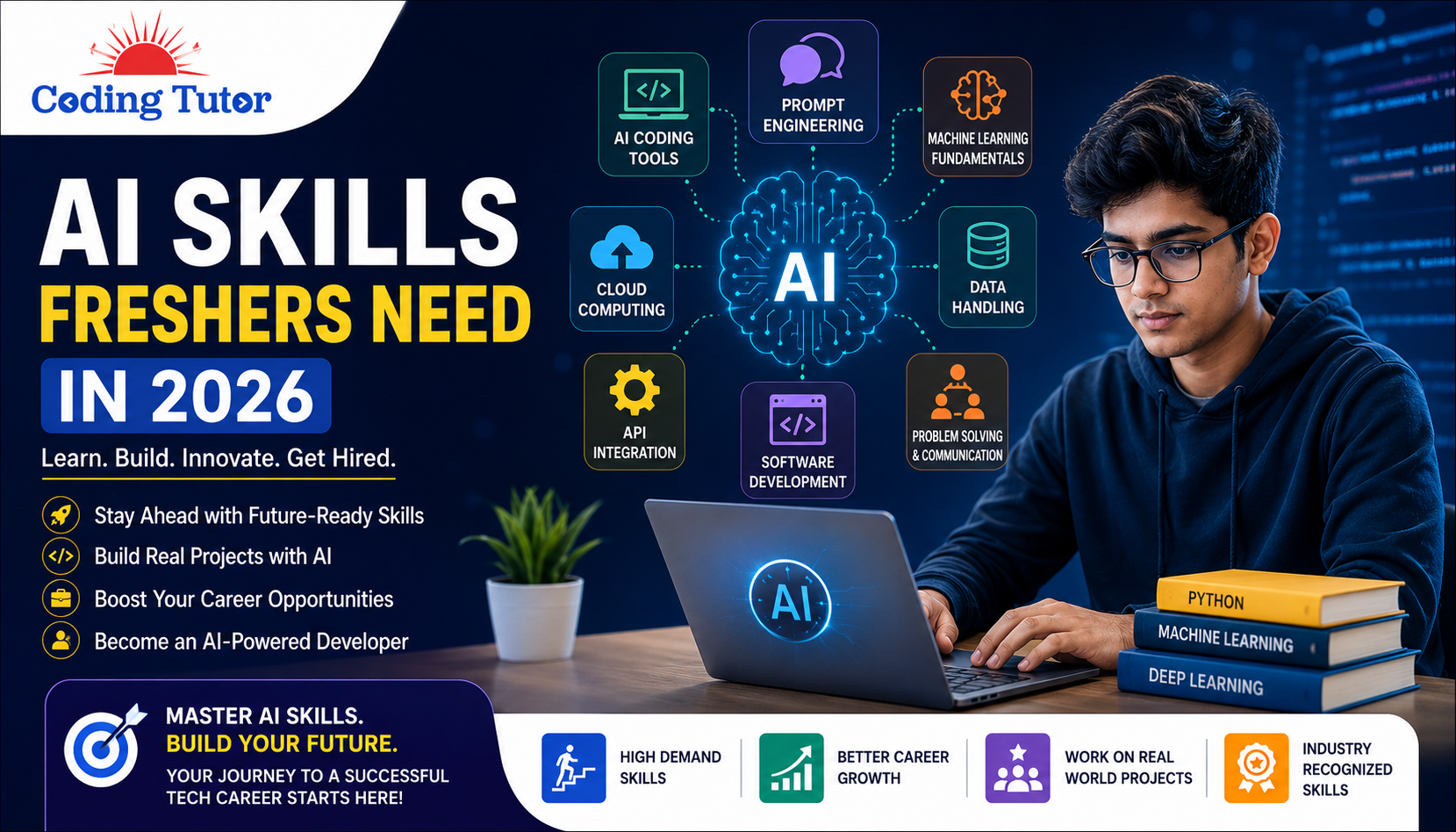
Getting your first software job has never been just about having a degree. And in 2026, the expectations are changing even faster.
Companies increasingly want developers who understand traditional software engineering and know how modern AI tools fit into development workflows. Current hiring coverage also points toward greater emphasis on AI skills, judgment, and problem solving during software engineering recruitment.
That does not mean every fresher needs to become a machine learning scientist. It means you need to understand how AI can make you a better software developer. Here are the skills worth prioritizing.
1. Strong Programming Fundamentals
Start with programming. Choose a language such as Java, Python, JavaScript, or C#, then become comfortable writing and understanding code without constantly depending on AI.
For Java, a useful path is OOP, collections, Spring Boot, REST APIs, databases, full stack, then AI integration. For Python: OOP, APIs, FastAPI or Django, databases, AI and LLMs, then deployment. AI becomes far more useful when your fundamentals are strong.
2. AI Coding Tools
You do not need to memorize every AI tool available. Learn the general workflow. Understand how AI coding assistants and coding agents can help with code generation, debugging, refactoring, testing, documentation, code explanation, and repository analysis.
The AI coding ecosystem is moving rapidly toward agentic workflows rather than simple autocomplete. Always review generated output. For more on this shift, read AI Coding Agents in 2026: Will Developers Still Need to Write Code?
3. Prompt Engineering
Prompt engineering is not about writing fancy sentences. For developers, it means giving AI enough technical context to produce useful results.
Instead of "Create login," try: create a Spring Boot REST API for user login using JWT authentication, including request validation, password hashing, exception handling, and unit tests. The second prompt gives the AI constraints. That is much closer to real software engineering.
4. Understand APIs and LLM Integration
One of the most practical AI skills for a software developer is learning how applications communicate with AI models. You do not necessarily need to train your own large language model. You should know how to integrate AI into applications.
- REST APIs
- JSON
- Authentication and API keys
- LLM APIs and prompt/response workflows
- Embeddings
- Vector databases
- Retrieval-augmented generation
5. Cloud Computing
Modern applications increasingly depend on cloud infrastructure. Freshers should understand the basics of platforms such as AWS, Azure, or Google Cloud: compute, storage, databases, networking, IAM, containers, deployment, and monitoring.
A developer who can build an application and deploy it has a stronger practical profile than someone who only runs projects locally.
6. Git and GitHub
This remains essential. Learn Git commits, branches, pull requests, merge conflicts, code reviews, and repository management. AI may write code, but professional software still needs version control and collaboration.
7. Data Structures and Problem Solving
Do not abandon DSA because AI can solve coding questions. Interviews still evaluate how you think. Practice arrays, strings, hash maps, linked lists, stacks, queues, trees, searching, sorting, and basic algorithms. More importantly, explain why your solution works.
8. Full-Stack Development
A fresher who understands the complete application flow has a valuable advantage. Learn how frontend, API, backend, database, and cloud work together. You do not have to master everything at once, but you should understand how the pieces communicate.
9. Testing and Code Quality
One underrated AI-era skill is knowing how to verify AI-generated code. Learn unit testing, integration testing, API testing, debugging, code review, and security basics. AI can produce code quickly. Your job is to determine whether the code deserves to be shipped.
10. Communication and Business Understanding
Technical skills get you into the conversation. Communication helps you work effectively once you are there. Learn to explain technical topics in simple language.
If a recruiter asks why you chose an architecture, do not answer that AI suggested it. Explain the actual technical reason. That is the difference between using AI and understanding software engineering.
What Does a Job-Ready Fresher Look Like in 2026?
A strong fresher does not need 25 technologies on their resume. Instead, they might have:
- One programming language
- One full-stack or backend stack
- Database knowledge
- Git and GitHub
- Cloud fundamentals
- AI integration
- Two to three meaningful projects
- Problem-solving and communication skills
That is a much stronger foundation.
A Practical 6-Month Learning Strategy
- Months 1–2: programming fundamentals, Git, SQL, and problem solving
- Months 3–4: full-stack or backend projects and APIs
- Month 5: add AI features using LLM APIs and AI coding tools
- Month 6: deploy projects, improve your resume, practice interviews, and build your portfolio
The exact timeline will vary by learner, but the principle remains: do not learn everything. Learn a useful combination deeply enough to build.
Why Real Projects Matter
Imagine two candidates. Candidate A completed 15 certificates. Candidate B built a working application with authentication, APIs, database integration, AI functionality, and cloud deployment. The second candidate gives an interviewer more evidence of practical capability.
That is why project-based learning matters. Learn more in How Real-Time Projects Help You Get Hired Faster and The Difference Between Learning to Code and Becoming Employable.
How Coding Tutor Fits Into This Skill Shift
Coding Tutor positions learning around the skills modern software teams need: Java with AI, Python with AI, Cloud with AI, real projects, Git and GitHub workflows, Agile development, and professional communication.
The objective is not simply to teach students another programming language. It is to help them understand how software is actually developed in an AI-assisted environment.
Final Thoughts
The 2026 job market does not require freshers to compete with AI. It requires them to learn how to work with AI. The winning combination is becoming clear: strong coding fundamentals, AI skills, real projects, problem solving, and communication.
Do not wait for the technology to settle down. It will not. Learn continuously, build continuously, and use AI as a tool to become a better developer—not as a replacement for understanding.